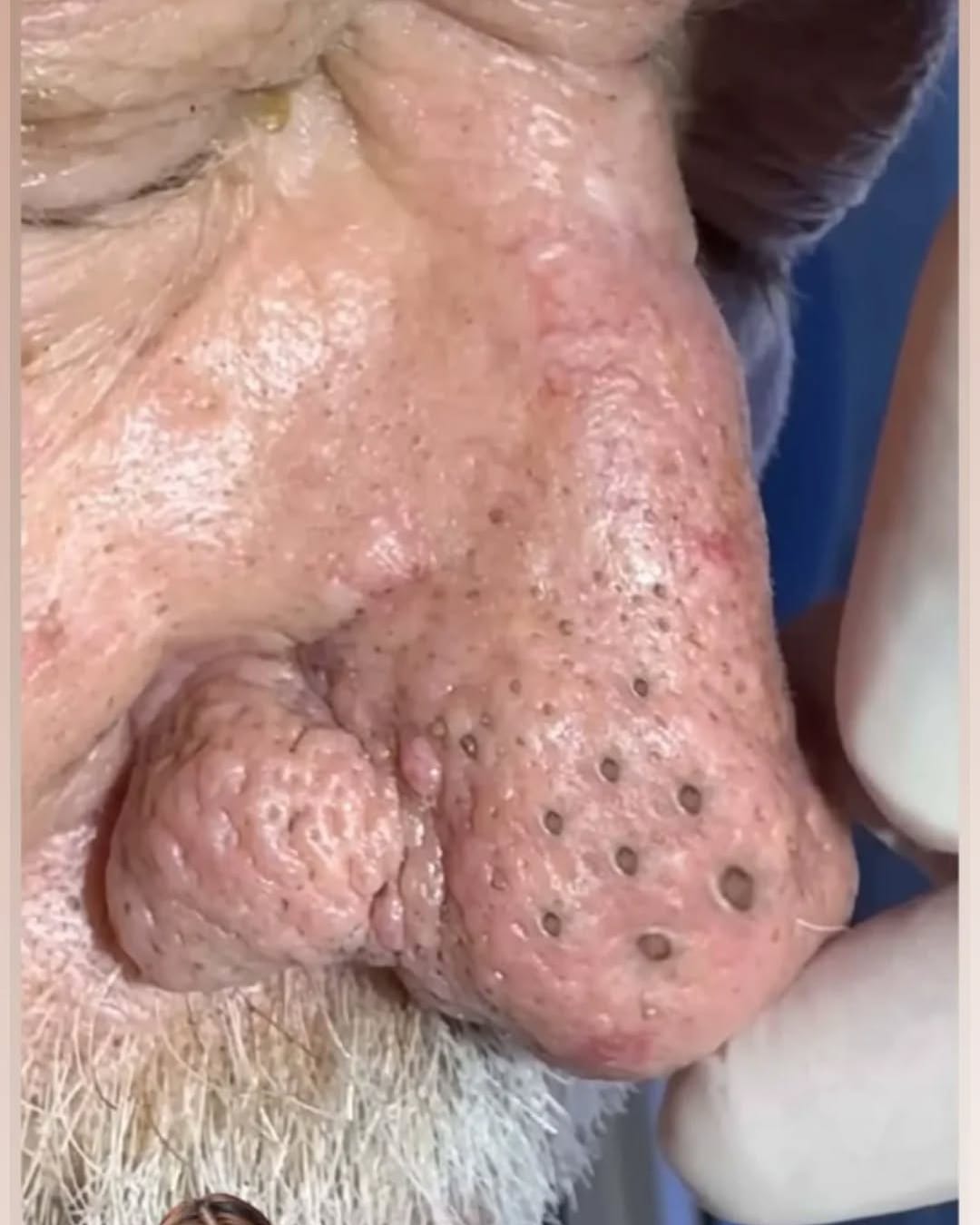
In the world of dermatology and viral “pimple popping” videos, few images are as visually arresting as the one shown above. We see a nose with a bulbous, uneven shape, thickened skin, and significantly enlarged pores filled with dark keratin plugs.
While often viewed with a mix of fascination and curiosity, this image depicts a very real, chronic medical condition known as Rhinophyma.
What is Rhinophyma?
Rhinophyma (pronounced ry-no-fy-ma) is a skin disorder characterized by a large, red, bumpy, and bulbous nose. It is actually considered a severe subtype of Rosacea (specifically phymatous rosacea).
While rosacea is a common condition causing redness and visible blood vessels in the face, Rhinophyma represents a late-stage progression where the skin undergoes physical changes.
The Pathology
The deformity is caused by the hypertrophy (overgrowth) of two specific things:
-
Sebaceous Glands: The oil-producing glands in the nose enlarge significantly.
-
Connective Tissue: The skin thickens and creates excess fibrosis (scar-like tissue).
As these tissues grow, the nose distorts, leading to the lobulated (lumpy) appearance seen in the photo.
The “Holes”: Why Are the Blackheads So Big?
One of the most striking features in the image is the presence of massive blackheads, medically known as Giant Comedones or Macrocomedones.
1. Hyperactive Oil Production
Because Rhinophyma involves the enlargement of sebaceous glands, oil production goes into overdrive. The nose is the oiliest part of the “T-zone” on the face, and in this condition, the glands are constantly pumping out sebum.
2. The Mechanics of the Pore
The “black” spots are not dirt. They are plugs made of sebum (oil) and keratin (dead skin cells). When this mixture collects in the pore and is exposed to air, the melanin oxidizes and turns dark black.
In a healthy nose, the pore clears itself. In a nose with Rhinophyma, the pore structure is stretched and distorted by the thickening skin. The debris gets trapped, continuing to accumulate until it creates these crater-like impactions.
The Stigma: The “Drinker’s Nose” Myth
For centuries, a bulbous red nose was unfairly associated with heavy alcohol consumption—often called a “Gin Blossom” or “Whiskey Nose.”
This is a myth. While alcohol causes vasodilation (flushing) which can temporarily worsen the redness of rosacea, alcohol does not cause Rhinophyma. The condition is largely genetic and hormonal. Teetotalers (people who never drink) can and do develop Rhinophyma.
Diagnosis and Demographics
-
Gender: It is overwhelmingly more common in men than women, likely due to hormonal influences (androgens) on the oil glands.
-
Age: It typically manifests in middle-aged to older adults (50 to 70 years old).
-
Progression: It happens slowly over years. It often starts as simple facial redness before the skin begins to thicken.
Treatment Options
The gloved hands in the photo suggest a medical intervention is underway. Because this is a structural change to the skin, creams and face washes will not cure it. Physical intervention is required.
1. Manual Extraction
A dermatologist or surgeon may start by manually expressing (squeezing) the large blackheads to clear the pores. This reduces the volume of the nose slightly and clears the field for surgery, but the pores will refill if the underlying tissue isn’t treated.
2. Surgical Resurfacing (The “Gold Standard”)
To fix the shape of the nose, the excess tissue must be removed. This is often done via:
-
CO2 Laser: This vaporizes the layers of thickened skin, essentially “sculpting” the nose back to a normal shape.
-
Electrosurgery: Using a heated loop wire to shave off the excess bumps.
-
Scalpel Excision: Traditional shaving of the tissue (tangential excision).
3. Medication
Oral Isotretinoin (Accutane) is sometimes prescribed in the early stages to shrink oil glands, but it cannot reverse the fibrotic tissue once the nose has become bulbous.
Conclusion
The image above might look painful or shocking, but for the patient, treatment is often life-changing. Rhinophyma can cause difficulty breathing (by blocking nasal passages) and significant psychological distress due to its appearance. With modern dermatological surgery, the excess tissue can be removed, and the nose can be restored to a natural, smooth appearance.