My father died in that house. The one he built with his own hands, the one where I’d run through sprinklers as a child, where my mother taught me to play the piano. It was more than a house; it was a living, breathing testament to our family, to a love I thought was eternal. When he left, that house was the only piece of him I had left. My anchor. My sanctuary.

Eine Nahaufnahme einer unglücklichen Frau | Quelle: Midjourney
Then she came. Years ago, a beautiful, vibrant woman, too young, too perfect. My stepmom. I never called her that to her face. To me, she was merely her. An intruder in the sacred space my mother had once occupied. An unwelcome shadow that grew larger with every passing year. And after he was gone, after the silence descended like a shroud, her presence became unbearable.
She started small. Little comments. “We’ll need to redecorate this room eventually,” or “This garden could really use a woman’s touch, couldn’t it?” Always with that soft, saccharine smile. Always with the implicit assumption that we meant her and me, living together in the house that was rightfully, unequivocally, MINE. My father’s will was clear. Everything to me.
But she didn’t care about wills. I saw it in her eyes. The way she lingered in the formal dining room, the way she ran her hand over the antique fireplace mantel, the way she subtly started rearranging my mother’s things, her things. She wanted to erase every trace of my real mother, to usurp her place entirely, to make this house hers. And I refused to let that happen.
I couldn’t confront her. She was too smooth, too poised. She’d just look at me with those wide, innocent eyes and feign concern, making me out to be the irrational, grief-stricken child. I needed proof. I needed undeniable evidence of her true intentions, of the scheming opportunist I knew she was. I needed to see what she did, what she said, when she thought no one was watching.
The idea came to me in a cold flash of fury and desperation. A silent trap.
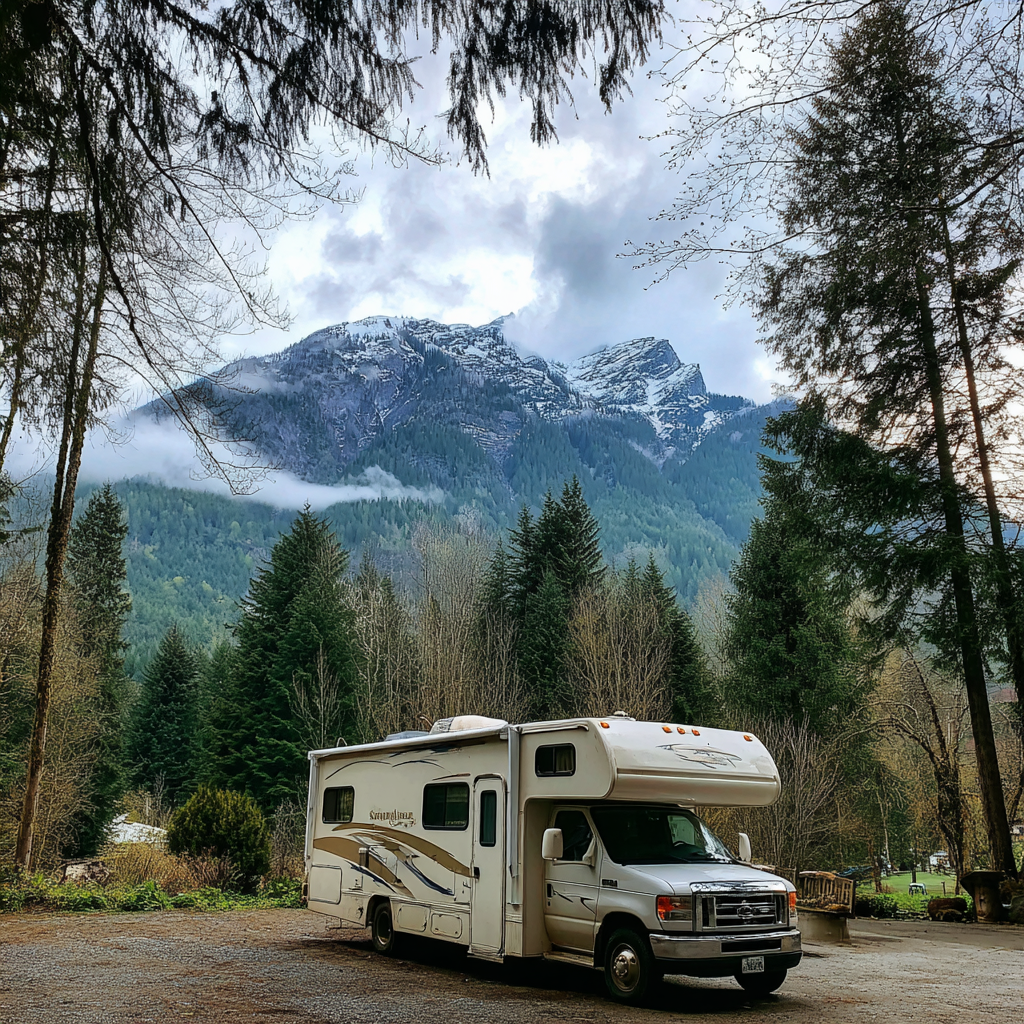
Ein geparktes Wohnmobil | Quelle: Midjourney
It was tiny. Imperceptible. A camera no bigger than my thumbnail, hidden discreetly behind a loose floorboard in my father’s study. The study. His sanctuary. The room where he spent his last quiet days. It was the place she frequented most, claiming she was “sorting through his papers” or “keeping his memory alive.” I knew better. I wanted to catch her celebrating, plotting, revealing her true, avaricious nature. I wanted to prove, beyond a shadow of a doubt, that she was nothing more than a gold-digger, a pretender.
The first few days were agonizing. I set up a loop recorder, storing hours of footage. Every night, after she’d gone to bed, I’d retreat to my room, headphones on, watching. I saw her walk around the study, sometimes touching his old leather chair, sometimes just sitting quietly. I saw her on the phone, her voice hushed, too low for the mic to fully pick up. Planning her next move, I thought, a bitter taste in my mouth. I saw her… crying. Soft, quiet tears, her shoulders shaking. Fake, I convinced myself. Practicing for her next performance. She’s trying to look distraught for whoever she’s talking to.
My anger simmered, a constant companion. She was talking about “the arrangements.” “The will.” My blood ran cold. She was manipulating things, I just knew it. She must be contesting it, or finding a loophole. My father had left everything to me. Everything.
Then, one evening, I finally caught something. Something that didn’t fit my narrative, but still fueled my rage. She wasn’t on the phone. She was standing in the study, alone, looking at a framed photograph on my father’s desk. It wasn’t a picture of him. It wasn’t a picture of her.
It was a picture of my mother. My beautiful mother, vibrant and smiling, her arm linked with my father’s.
And then I heard it. Clear as day, her voice trembling slightly. “I promise I won’t let her down. I’ll take care of it, just like you asked.”
What in the absolute HELL was she talking about? Let her down? My mother? My father’s will was explicit. The house was mine. What promise? What arrangement? This wasn’t the conniving proof I wanted. This was… confusing. My stomach churned. This was a new level of manipulation. Was she trying to pretend she was honoring my mother? It felt like a sick game.
I went back, scrubbing through weeks of footage. I started scrutinizing every detail. Her hushed phone calls, the documents she handled. She was always so careful, so secretive. I saw her making regular trips to a specific bank, always carrying a large, nondescript envelope. Proof, I thought again, she’s moving my money, siphoning funds.
Then, she did something unexpected. Something that made me freeze. She pulled out an old, dusty wooden box from under my father’s desk. A box I’d never seen before, tucked away in a hidden compartment I didn’t even know existed. It looked ancient. Reverently, she carried it to the desk, her movements slow, almost ritualistic.
She opened the box.
It was full of letters. Yellowed, fragile envelopes tied with a faded blue ribbon. My mother’s handwriting. My breath caught in my throat. I watched, my heart hammering against my ribs, as she slowly, carefully, picked one up.
And then, she started to read. Her voice was barely a whisper at first, then grew stronger, filled with an emotion I couldn’t place. Not sorrow, not anger, but something deeper, a profound sense of… duty?
She read aloud from the letter, written in my mother’s elegant script, dated just weeks before she passed. Her voice, my mother’s words, filling the silent study. It was addressed to “My Dearest Husband, and My Beautiful Friend.”
My… beautiful friend?

Ein schöner Wanderweg | Quelle: Midjourney
The letter spoke of my mother’s illness, the rapid decline she knew was coming. It spoke of her love for my father, and for her. It spoke of a desperate plea. A request.
My mother had begged them, both of them, to raise me together. To protect me. Not just from grief, but from something else. A devastating secret related to the house’s history. A bitter, ancient land dispute with a long-estranged branch of my father’s family, a claim that could strip me of everything. My mother had worried that my father, already broken by her impending death, would not have the strength to fight it alone.
She had specifically requested that her closest friend, my stepmom, be the one to secure the house and its contents for my future. To manage the legal battle, to ensure the inheritance was truly safe, truly mine. The “arrangements,” the “will” discussions, the bank trips with envelopes… it wasn’t about her trying to take my inheritance. It was about her fiercely protecting it FOR ME.
MY MOTHER AND HER. They were friends. Best friends. And my father had, in his grief and sickness, simply made the will straightforward, trusting his wife, my mother’s friend, to carry out the real, complex plan to safeguard my future. He couldn’t tell me, couldn’t bear the weight of it, and she, my stepmom, had silently borne the burden, the task, the promise.
ALL THIS TIME. EVERY SINGLE DAY I HAD HATED HER. I had seen her as a usurper, a gold-digger, a villain. I had subjected her to surveillance, fueled by a corrosive, burning rage. I had almost destroyed the very person who was doing everything in her power to safeguard my future, based on a sacred pact made by the two people I loved most in the world.
THE SILENT TRAP. It wasn’t just silent. It was a mirror. And it didn’t catch her. It caught me. It exposed my own blind hatred, my own devastating ignorance. And now, the silence of that house screams with a new, unbearable truth. I didn’t lose my house. I lost my mother’s last legacy of trust, because I failed to trust. And I have no idea how to ever tell her what I did.