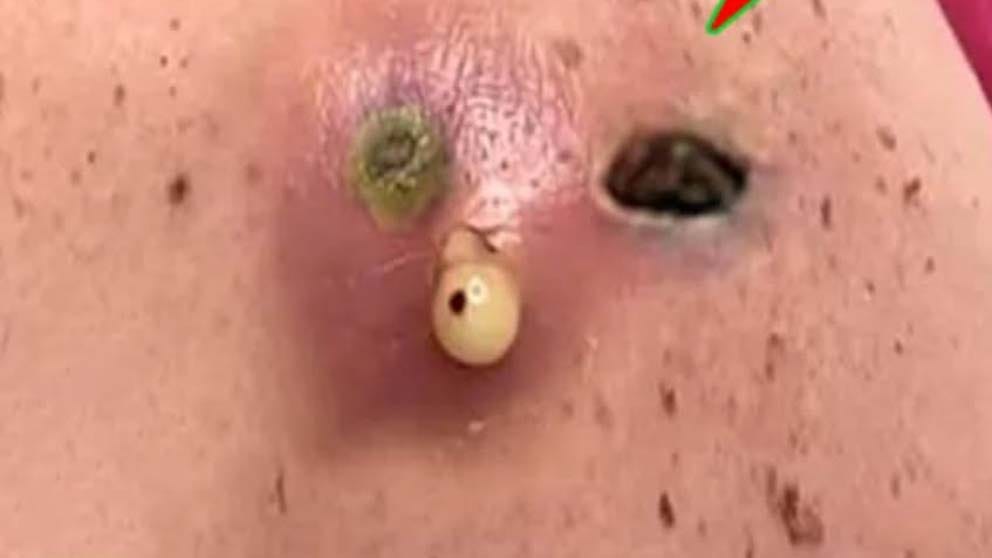
In the endless scroll of social media, few things stop a user in their tracks quite like a shocking medical image. The picture in question—a close-up of a person’s back featuring a massive, inflamed, and complex skin lesion—is a prime example. With a bright green arrow pointing to a cluster of worrying symptoms, it is the quintessential “clickbait” thumbnail designed to elicit a mix of horror, curiosity, and an uncontrollable urge to see more.
This image is part of a larger, immense internet phenomenon: the “pimple popping” community. Videos of dermatological extractions, spearheaded by figures like Dr. Sandra Lee, known globally as Dr. Pimple Popper, have garnered billions of views. Her reality television series on TLC follows her as she treats patients with unusual and severe facial and skin disorders, from giant lipomas to extensive cysts. But what exactly is being shown in this graphic image, what causes such a severe condition, and why are millions of people so fascinated by watching it be treated?
Deconstructing the “Horror”: What Is That on the Patient’s Back?
The image presents a constellation of symptoms that point to a serious dermatological issue. The area is defined by intense redness and swelling, indicating significant inflammation and infection deep within the skin. There are three distinct focal points within the lesion:
-
The Protrusion: In the center, a spherical, yellowish-white mass is actively pushing out of the skin. This is likely a “plug” of thick pus or keratin, the protein that makes up skin and hair.
-
The Crust: To the left is a greenish, crusted area, suggesting an older site of drainage or infection that has begun to dry on the surface.
-
The Cavity: To the right is a dark, gaping hole, which could be an open pore from which material has already been expelled.
Based on these visual cues, a dermatologist would likely consider two primary diagnoses: a severe carbuncle or a ruptured and infected epidermoid cyst.
A carbuncle is a painful cluster of boils that form a connected area of infection under the skin. While a single boil is an infection of a hair follicle, a carbuncle is a deeper and more severe infection that involves a group of follicles. They are most common on the back and neck and often have multiple “heads” or openings through which pus drains, matching the multiple sites seen in the image.
Alternatively, it could be an epidermoid cyst that has ruptured. These cysts are slowly growing bumps under the skin filled with a cheesy, foul-smelling substance called keratin. If the sac holding the keratin breaks under the skin, the body’s immune system attacks the material as a foreign invader, causing massive inflammation, pain, and the formation of an abscess (a pocket of pus).
The Causes and Dangers of DIY Treatment
The primary cause of boils and carbuncles is a bacterial infection, most commonly Staphylococcus aureus (staph bacteria). The bacteria can enter the skin through a cut, scratch, or hair follicle, triggering the body’s immune system to send white blood cells to fight the infection. The buildup of bacteria, dead white blood cells, and dead skin cells forms pus.
Certain factors can increase the risk of developing such severe infections, including having a weakened immune system, diabetes, or other skin conditions like dermatitis.
The most critical takeaway from such an image is the danger of trying to handle it at home. Squeezing or popping a boil or cyst yourself can spread the infection deeper into the tissues or even into the bloodstream, potentially leading to serious complications like sepsis. It can also lead to permanent scarring. Dermatologists strongly advise against “DIY surgery” and recommend seeing a professional for safe and effective treatment.
The Medical Procedure: What Happens in the Video?
For a lesion of this magnitude, a visit to a dermatologist like Dr. Sandra Lee is essential. The procedure to treat it, which is what millions tune in to watch, typically follows a standard medical protocol:
-
Anesthesia: The doctor will first numb the entire area with a local anesthetic to ensure the patient feels no pain during the procedure.
-
Incision: Using a sterile scalpel, the dermatologist will make a careful incision across the abscess to create an opening.
-
Extraction (The “Pop”): This is the moment viewers wait for. The doctor will apply pressure around the lesion to drain the accumulated pus, blood, and keratin. The amount of material that comes out can be shocking.
-
Removal of the Sac: If the lesion is a cyst, it is crucial for the doctor to remove the entire cyst wall, or sac. If any part of the sac is left behind, the cyst is likely to grow back. This often involves using forceps and scissors to carefully dissect the sac from the surrounding tissue.
-
Aftercare: Once the area is thoroughly cleaned, the wound may be packed with sterile gauze to allow it to heal from the inside out, or it may be stitched closed, depending on the size and nature of the cavity.
The Psychology of the “Pop”: Why Do We Watch?
The immense popularity of videos depicting these procedures is a fascinating psychological phenomenon. Why do so many people seek out content that others find repulsive? Experts propose several explanations:
-
A Rush of Dopamine: For many, watching the successful extraction of a cyst or blackhead provides an immediate sense of relief and satisfaction. This feeling of accomplishment can trigger the release of dopamine, the brain’s “feel-good” hormone.
-
Morbid Curiosity and Safe Disgust: Humans have an innate “morbid curiosity” for negative or grotesque content. Watching these videos allows people to experience disgust—an emotion that evolved to help us avoid disease—from a safe distance without any real danger to themselves. It’s a form of “benign masochism,” similar to enjoying a horror movie or a super-spicy meal.
-
The “Curiosity Gap”: Thumbnails like the one above are masterclasses in creating a “curiosity gap.” They show a shocking problem but withhold the resolution. This psychological gap between what we know and what we want to know drives a powerful urge to click and find out what happens next.
-
Therapeutic and Soothing: Paradoxically, many fans find these videos to be relaxing, stress-relieving, and even cathartic. The buildup of tension followed by the release of the “pop” can have a soothing effect for some viewers.
In conclusion, the shocking image of the back lesion is more than just gross-out clickbait; it is a gateway into a complex world of dermatology, human psychology, and modern media consumption. It highlights a severe medical condition that requires professional care while simultaneously tapping into the deep-seated, and sometimes inexplicable, human fascination with the grotesque and the satisfying release of pressure.